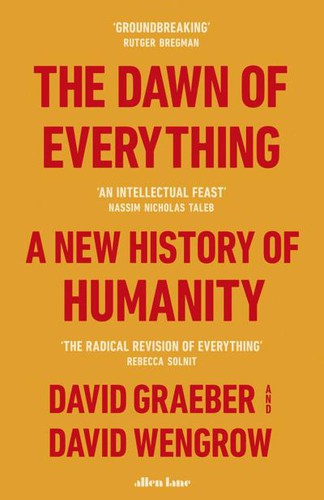
The renowned activist and public intellectual David Graeber teams up with the professor of comparative archaeology David Wengrow to deliver a trailblazing account of human history, challenging our most fundamental assumptions about social evolution—from the development of agriculture and cities to the emergence of "the state," political violence, and social inequality—and revealing new possibilities for human emancipation
For generations, our remote ancestors have been cast as primitive and childlike—either free and equal innocents, or thuggish and warlike. Civilization, we are told, could be achieved only by sacrificing those original freedoms or, alternatively, by taming our baser instincts. David Graeber and David Wengrow show how such theories first emerged in the eighteenth century as a conservative reaction to powerful critiques of European society posed by Indigenous observers and intellectuals. Revisiting this encounter has startling implications for how we make sense of human history today, including the origins of farming, property, …
The renowned activist and public intellectual David Graeber teams up with the professor of comparative archaeology David Wengrow to deliver a trailblazing account of human history, challenging our most fundamental assumptions about social evolution—from the development of agriculture and cities to the emergence of "the state," political violence, and social inequality—and revealing new possibilities for human emancipation
For generations, our remote ancestors have been cast as primitive and childlike—either free and equal innocents, or thuggish and warlike. Civilization, we are told, could be achieved only by sacrificing those original freedoms or, alternatively, by taming our baser instincts. David Graeber and David Wengrow show how such theories first emerged in the eighteenth century as a conservative reaction to powerful critiques of European society posed by Indigenous observers and intellectuals. Revisiting this encounter has startling implications for how we make sense of human history today, including the origins of farming, property, cities, democracy, slavery, and civilization itself.
Drawing on pathbreaking research in archaeology and anthropology, the authors show how history becomes a far more interesting place once we learn to throw off our conceptual shackles and perceive what’s really there. If humans did not spend 95 percent of their evolutionary past in tiny bands of hunter-gatherers, what were they doing all that time? If agriculture, and cities, did not mean a plunge into hierarchy and domination, then what kinds of social and economic organization did they lead to? What was really happening during the periods that we usually describe as the emergence of "the state"? The answers are often unexpected, and suggest that the course of human history may be less set in stone, and more full of playful, hopeful possibilities, than we tend to assume.
The Dawn of Everything fundamentally transforms our understanding of the human past and offers a path toward imagining new forms of freedom, new ways of organizing society. This is a monumental book of formidable intellectual range, animated by curiosity, moral vision, and a faith in the power of direct action.
That took me a long while but damn was it interesting
5 stars
Hoo boi a long read for sure. Maybe we should improve society somewhat... Or at the very least remember that our social structures are not set in stone but things we can decide to change. We may have lost the freedom to move away, to disobey orders along the way, but we should not relinquish the last freedom to imagine and put in place a different social order, and maybe we can get the first two freedoms back along the way
This book suffers from two things in terms of its writing and structure. First, there's Graeber's desire to compress as much information into one space as humanly possible, even to the detriment of his own argument and the discussion he wants to push people to have. The second is that it seems, if I'm reading into both authors' writing styles correctly, Wengrow's desire to flesh out those concepts with more detail to further support them. (I say that because I've checked a few of his articles, and he has a tendency to develop even more focused detail than Graeber.)
I could be wrong about who was doing what, but regardless? The end result is a book that is a slog to get through and frequently leaves me forgetting half of what I've read, going back to skim it and remind myself about what they were discussing, and then trying …
This book suffers from two things in terms of its writing and structure. First, there's Graeber's desire to compress as much information into one space as humanly possible, even to the detriment of his own argument and the discussion he wants to push people to have. The second is that it seems, if I'm reading into both authors' writing styles correctly, Wengrow's desire to flesh out those concepts with more detail to further support them. (I say that because I've checked a few of his articles, and he has a tendency to develop even more focused detail than Graeber.)
I could be wrong about who was doing what, but regardless? The end result is a book that is a slog to get through and frequently leaves me forgetting half of what I've read, going back to skim it and remind myself about what they were discussing, and then trying to figure out what most of it has to do with the point being made. Which, yeah, the topics discussed do relate. But it's such a winding detour through excruciating detail that it makes it hard to focus on the overall picture that they're trying to get us to see.
So much of this would've benefitted from focused case studies rather than intertwining and switching between each of them. It also would've dealt better with more clear (instead of verbose and annoyingly lengthy) section titles that could serve as functional reminders rather than quippy sayings.
Overwhelmingly, I wasn't amused with most of this. Despite the obvious amount of time this had to have taken in order to gather all the resources and research, the writing feels rushed and confused. It doesn't feel nearly as solid as it really could've been.